Summary
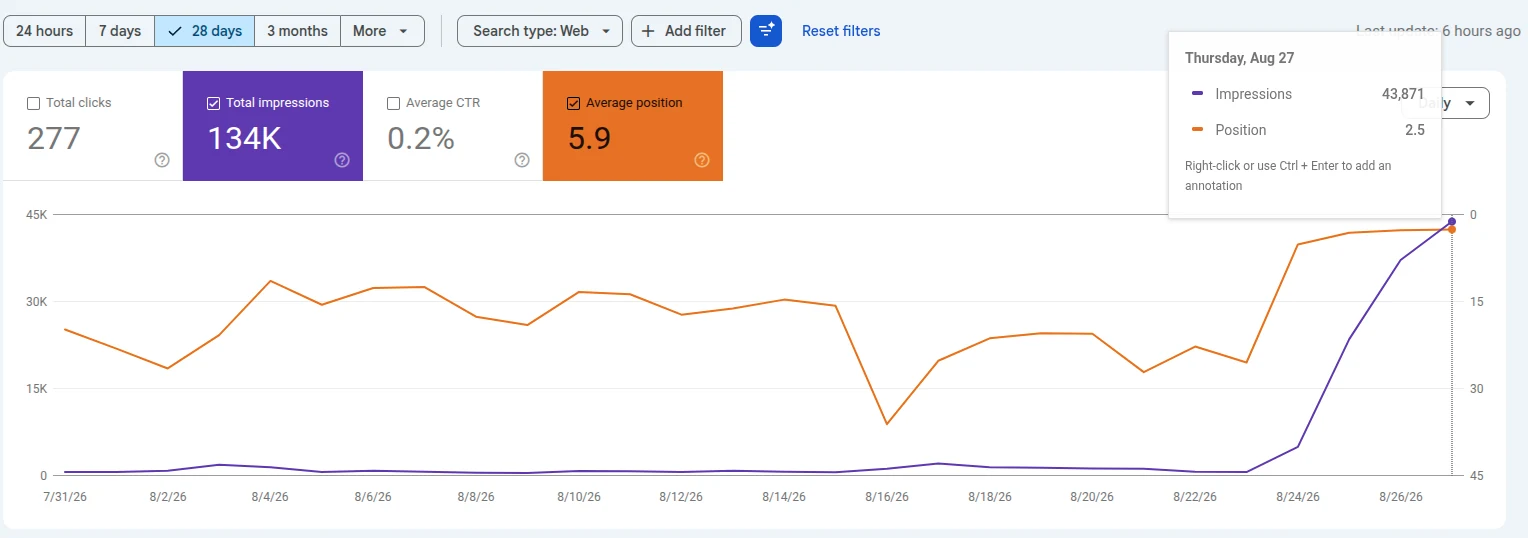
In late August 2026, WrenchConnect (wrenchconnect.org) broke out from a regional automotive directory into a national programmatic search powerhouse. In its first surge, weekly Google Search impressions leapt from 8,976 to 112,408, averaging 134K impressions over 28 days with an average position of 5.9.
Over the following three weeks through September 15, 2026, that visibility did not revert — it multiplied. Rolling 28-day impressions crossed 1,020,000 (1.02M) — a 7.6x monthly expansion — with cumulative 3-month impressions passing 1.1 million. Crucially, average search position locked at 2.5 nationwide, while single-day impression peaks reached over 115,000 impressions.
This case study documents the Search Console record, why this traffic holds, and how the infrastructure handled millions of crawler hits and searcher queries without degradation.
The Search Console record (September 2026)
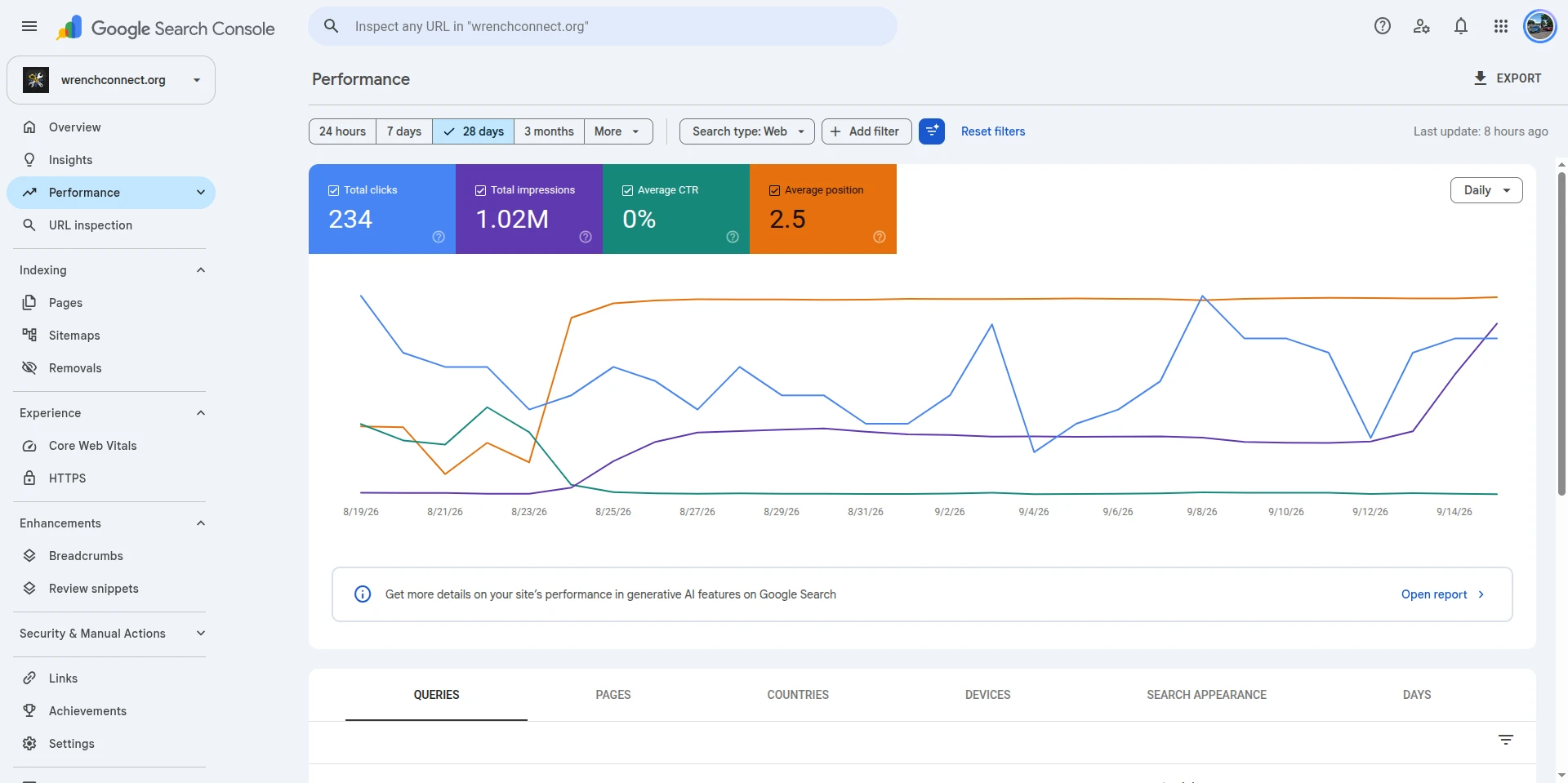
wrenchconnect.org, 28-day verified performance to September 15, 2026. The purple line is search impressions (1.02M total, climbing past 115K/day). The orange line is average position (locked in at 2.5 from August 24 through mid-September). The blue line tracks clicks (234). Holding position 2.5 steadily across seven figures of impressions confirms programmatic relevance across the entire 70,173-shop catalog.Milestone progression
| Phase / Timeframe | Impressions | Clicks | Avg position | Key dynamic |
|---|---|---|---|---|
| Week 1 — Aug 7–13 | 5,103 | 76 | 15.3 | Regional baseline before programmatic sweep |
| Week 2 — Aug 14–20 | 8,976 | 77 | 23.0 | National sitemaps submitted; initial indexing crawl |
| Week 3 — Aug 21–27 | 112,408 | 54 | 3.3 | First visibility surge (+1,152% WoW), peak 43.8K/day |
| 28 Days to Sep 15 | 1,020,000 | 234 | 2.5 | 1.02M sustained scale (+661% over Aug 28d); daily peaks >115K |
3-month cumulative totals in Google Search Console reached 1,100,000+ impressions and 726 clicks. The average position chart demonstrates consistent ranking in positions 1–3 for targeted local automotive intent.
The initial breakout (August 2026 baseline)
For comparison, below is the original Search Console capture from August 27, 2026, when the site initially broke through 100K weekly impressions:
The problem with programmatic directories
Local automotive search is fiercely contested by legacy directories (Yelp, RepairPal, YellowPages) and dealership networks. A newly launched programmatic directory typically runs into three major traps:
- Indexation lag & crawl budget starvation. Large sets of generated pages get crawled sluggishly or discarded as duplicates.
- Low intent capture. Vague or generic meta descriptions fail to capture searchers facing an immediate mechanical failure.
- Thin-content penalties. Aggregators that copy-paste basic business listings offer search engines zero distinctive value to justify ranking.
How we engineered the breakthrough
Programmatic hierarchy and partitioned sitemaps
A clean, logical semantic taxonomy — /[state]/[city]/[shop-slug] — structured across 70,173 verified US repair shops. Each listing contains verified phone contact, geographic coordinates, operating hours, review scores, and recognized repair capabilities. Sitemaps are partitioned into index-safe buckets with true lastmod timestamps, submitted directly via the Search Console API.
Intent-first snippets
Automotive searchers are often stranded or actively troubleshooting. Rather than promotional marketing prose, our generated meta description leads directly with high-utility emergency data:
📞 (817) 433-0560. (5.0★, 2 rev) Auto repair in Hurst, TX.
Open 8:00 AM – 6:00 PM. Get verified hours, phone & run a free
AI car diagnosis before your visit.
Phone number acts as the instant visual anchor, review ratings establish immediate social proof, and free AI diagnostics provides an actionable problem-solving hook no competitor offers.
Structured data completeness
Every shop page outputs strict AutoRepair Schema.org JSON-LD: hasOfferCatalog with indexed repair services, accurate geo coordinates, strict postalCode and addressLocality binding for local map pack alignment, and interactive potentialAction metadata.
Real utility: Interactive Maps & Vertex AI Diagnostics
WrenchConnect provides immediate functionality. The Google Maps JavaScript SDK provides dynamic radius recalculation and viewport bounding. Searchers can describe symptoms or input OBD-II codes directly into an AI intake engine powered by Gemini, giving them immediate diagnostic clues before contacting a shop.
Understanding the CTR dynamic: Intent vs Ranking
One of the most valuable insights from 1.02 million impressions is search query intent segmentation:
- Emergency and problem queries convert with high CTR: Searches like
mobile diesel mechanic near me(60.0% CTR, pos 1.0),24 hour tire shop near me(33.3% CTR, pos 2.0), andtire shops near me(9.1% CTR, pos 2.6) deliver immediate engagement. - Navigational queries earn massive impressions with low CTR: When a searcher types a specific local business name (e.g.
geneseo collision), Google frequently displays WrenchConnect in position 1–3 alongside the business's own direct website. Because searchers predominantly click the shop's direct homepage, directory CTR on pure navigational terms remains low (0.1%–0.2%). - The strategic roadmap: We intentionally prioritize problem-shaped surfaces (
/obd2-codes,/symptoms,/services) where user intent is transactional and diagnostic, earning significantly higher conversion per impression.
The infrastructure underneath
A surge from 8.9K weekly impressions to over 115K daily impressions is only a victory if the server cluster stays online. WrenchConnect operates active-active across three physical host nodes in the MRB Technologies estate, fronted by a redundant Traefik edge pool:
                [ Public ingress VIP ]
                           │
        ┌──────────────────┼──────────────────┐
        ▼                  ▼                  ▼
   [ Traefik edge a ]  [ edge b ]        [ edge c ]
        └──────────────────┼──────────────────┘
                           │
        ┌──────────────────┼──────────────────┐
        ▼                  ▼                  ▼
   [ app node a ]     [ app node b ]     [ app node c ]
(host 1) (host 2) (host 3)- Active-active round robin distributing crawler and visitor requests evenly across independent physical hardware.
- Compound health probes verifying both the Next.js SSR frontend and the FastAPI backend simultaneously, ejecting degraded nodes in milliseconds.
- 100% uptime through the surge with sub-15ms edge response times, ensuring Googlebot never encountered crawl budget timeouts or gateway errors.
Key takeaways
- Information density dominates local SERPs. Immediate phone numbers, operational hours, and ratings in search snippets reliably capture top-3 rankings over generic aggregation.
- Infrastructure speed protects crawl budget. Fast, cache-coherent responses allow search engine bots to crawl and index tens of thousands of programmatic URLs without throttling.
- Combine directory depth with utility. Pairing exhaustive regional coverage with genuine interactive utility (AI diagnostics + map search) transforms a directory into a destination.
- Transparent metrics over vanity claims. We publish raw, uncropped Search Console records — including the realities of navigational CTR — because genuine engineering is measured by data.